Training article
Heat acclimatisation for endurance athletes
How to prepare for hot-race performance
Heat can be one of the biggest performance limiters in endurance sport, but the good news is that heat tolerance is trainable.
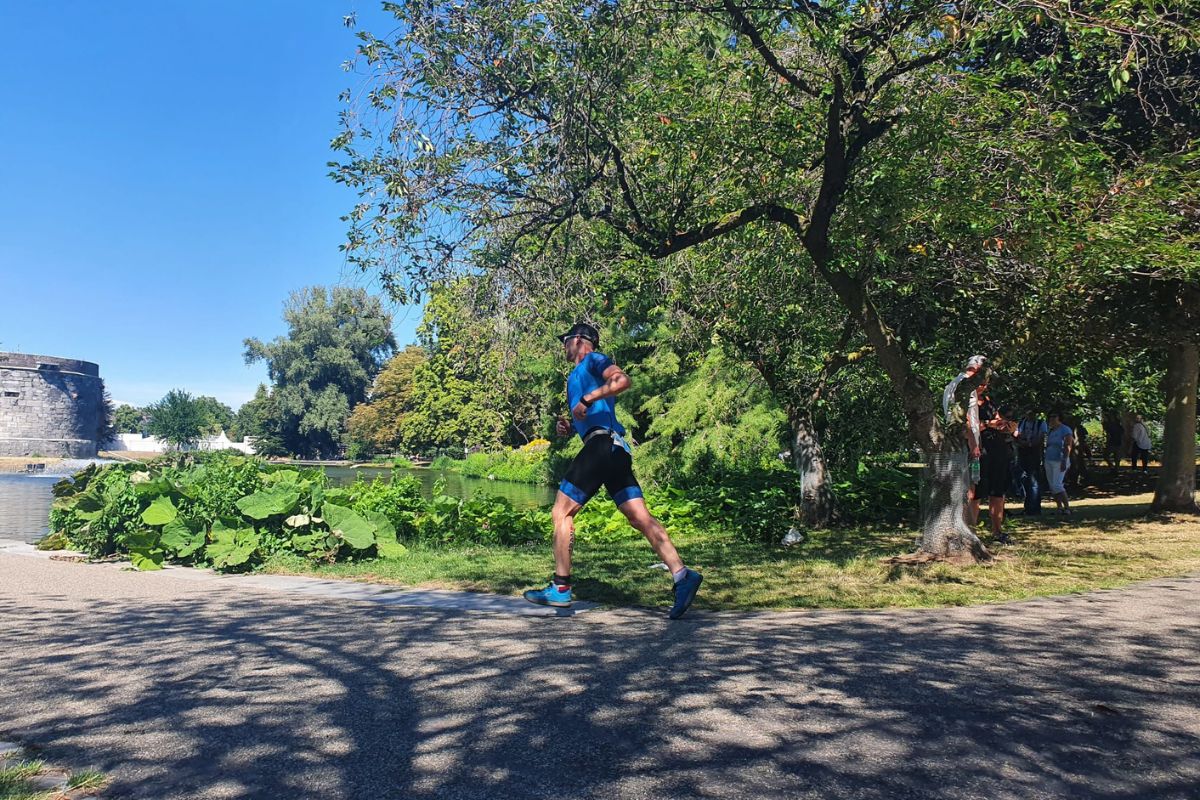
Whether you're preparing for a marathon in Spain, an Ironman in a tropical climate or a cycling event during a European heatwave, exercising in hot conditions places additional demands on the body. Heart rate rises, sweating increases, cardiovascular strain increases, and the same pace or power can feel considerably harder.
With repeated exposure to heat, the body makes a series of adaptations that allow you to regulate temperature more effectively. In an ideal world, this would mean a couple of weeks somewhere exotic in the lead-up to a major race, but for most of us, this isn't realistic.
Fortunately, research shows that there are several practical ways of stimulating heat adaptation without booking a flight.
What is heat acclimatisation?
Heat acclimatisation is the process of repeatedly exposing the body to heat, resulting in physiological adaptations that improve tolerance to exercising in hot conditions.
The adaptations are remarkably comprehensive. They affect the cardiovascular system, sweating response, skin blood flow, fluid balance, perception of effort and the body's ability to dissipate heat.
What actually changes when you acclimatise?
Your cardiovascular system becomes more efficient
One of the early responses to heat acclimation is an expansion of plasma volume (the fluid element of your blood). This means blood pressure and cardiac output (pumping blood around) can be better maintained while blood is simultaneously being directed towards the skin. Once there, heat is dissipated through sweat, which is essentially taken from your blood plasma, and when the sweat evaporates, heat escapes with it.
As acclimation develops, athletes typically experience:
- Lower heart rate at a given workload
- Increased stroke volume
- Improved cardiovascular stability
- Better maintenance of blood flow during exercise
This is important because exercising in the heat creates a competition for blood flow, and heat acclimation helps the cardiovascular system manage this challenge more effectively.
You start sweating earlier and more effectively
Sweating is one of the body's most important cooling mechanisms.
With heat acclimation, the body generally begins sweating at a lower core temperature and produces more sweat during exercise, therefore dissipating heat more effectively.
Heat acclimation also changes the composition of sweat. The sweat glands become better at conserving sodium, meaning sweat generally becomes more dilute and better avoids drifting towards hyponatremia (low blood-sodium levels), a serious condition that many misinterpret as dehydration.
Your body becomes better at controlling core temperature
Following heat acclimation, athletes typically experience lower core and skin temperatures during a given exercise workload.
Earlier sweating and improved skin blood flow allow heat to be transferred away from the body's core more effectively.
The body therefore stores heat more slowly, which helps delay the point at which rising temperature becomes a major limitation to performance.
Skin blood flow improves
Heat acclimation improves the body's ability to increase skin blood flow and therefore improves its capacity to transfer heat from the core towards the body's surface.
This contributes to the reduction in cardiovascular strain seen after acclimation.
Fluid regulation improves
Heat acclimation triggers adaptations to the production of hormones such as aldosterone and antidiuretic hormone, which help the body retain both water and sodium.
The result is improved fluid balance and a greater ability to maintain cardiovascular function during prolonged exercise in the heat.
The heat feels easier
Not all adaptations are physiological.
Heat acclimation can also improve thermal comfort and reduce perceived exertion during exercise in hot conditions. Reducing that perceptual strain can make it easier to maintain an appropriate pace or power output, rather than backing off prematurely.
How long does heat acclimatisation take?
A significant proportion of the adaptations to heat occur during the first week of repeated exposure, with further adaptations developing during the second week.
Consensus recommendations generally suggest 1–2 weeks of repeated exercise-heat exposure for athletes preparing for competition in hot conditions. However, with life being as it is, and training adaptations always needing consistency, I would suggest starting at least 4 weeks out from your event. That gives you time to get the logistics of exposure set up and to get into a habit.
How can you acclimatise without going abroad?
There are several ways of creating a heat stimulus without spending two weeks training overseas.
1. Train in the heat
Exercise in a genuinely hot environment and allow your body temperature to rise while maintaining a controlled training intensity. Traditional research protocols have commonly used temperatures around 30–40°C, with exercise performed at a low to moderate intensity.
It is really important that your training truly is at a lower intensity, because trying to carry out your normal high intensity sets is a recipe for heat distress rather than gently encouraging adaptations, which is our goal. Let the heat exposure do its job. You will have other opportunities for that smashfest.
Training in the heat can mean being out in the heat of the day in the summer, or it could mean indoors training in a warm room. The latter also requires care. Make sure the room you are training in is properly ventilated, because as your sweat evaporates it will expel humidity into the air, and without ventilation that humidity will create a lower oxygen environment. Trust me, you do not want to faint whilst still clipped into a bike on a turbo trainer. Messy…
2. Exercise first, then use passive heat
For the reasons above, this is personally my preferred method for my athletes.
Complete your normal training session in a temperate environment, then immediately expose yourself to heat. Examples include:
- Hot-water immersion
- Sauna
- Other forms of passive heat exposure
The advantage is that you can maintain the quality of your training session without the heat compromising your power, pace or technique.
The exercise raises your core temperature first. Passive heating then extends the period of thermal strain, providing an additional heat stimulus.
Hot-water immersion
40°C
Research has commonly used water at approximately 40°C for around 30–40 minutes following exercise.
Sauna
15–40 min
Research protocols vary, but studies have commonly used approximately 15–40 minutes of post-exercise sauna exposure.
The evidence suggests that post-exercise sauna and hot-water immersion can produce broadly similar heat-acclimation adaptations when used as part of an appropriate programme.
With my athletes, we have found that about 15 minutes of post-strength-training sauna exposure has been quite effective. Logistically, because many gyms have a sauna, it is the method most likely to be repeated.
I must stress, the goal isn't to see how long you can stay in the sauna. The goal is to provide a repeatable thermal stimulus without compromising your overall training programme.
Do you need to train in the heat every day?
The research shows that repeated exposures are important, but protocols vary considerably.
Traditional exercise-heat-acclimation programmes often use daily exposure for around 7–14 days, while passive heating studies have used anything from several consecutive days to around three sessions per week.
I would prioritise consistency and repeatability over trying to maximise heat exposure at every opportunity. Whatever method you go for, it needs to fit within your training programme without compromising your progress.
In practice
A very simple protocol
Recently with an ultrarunner, we followed a very simple protocol:
- Sauna after every strength session
- 1–2 low-intensity treadmill runs in the gym, where it probably wasn't quite 30–40°C, but warm enough
- 1 run at the weekend in the heat of the day, but on relatively short loops around where he lived so he could stop to grab fluids or a quick break in the shade. His exposure was still a stimulus and not a gruelling slog
In total he probably had 5 days of exposure per week over a 4-week period. He then went and smashed the Marathon des Sables, even getting stronger over the 6 days!
When should you do your heat acclimation?
As mentioned above, I really like my athletes starting a heat acclimation protocol at least 4 weeks out. The research might indicate adaptations within 14 days, but let's face it, it's yet another thing to be on top of and the logistics of following a protocol aren't always easy. So for me, 4 weeks gives us time to work out the kinks.
Do remember though, if you are travelling to the hot environment before the race, the time spent there can also provide an opportunity for further acclimation. If it is a major event, something like Kona or another world champs, going out a week before can do wonders for your heat acclimation as well as just your general ability to relax in the environment. Don't underestimate what feeling relaxed in your environment can do for your performance.
How can you tell if you are adapting?
The easiest way is to have at least one low-intensity session that is repeated over the course of the protocol, and to monitor your heart rate closely. Hopefully, in time, you'll see:
- Lower heart rate at the same workload
- Lower perceived exertion
- Earlier onset of sweating
- Increased sweat rate
- Improved thermal comfort
- Lower body temperature responses
The key message
You don't need to fly to a hot country to prepare for a hot race.
Repeated heat exposure at home — particularly exercise followed by passive heat exposure such as a sauna or hot-water immersion — provides a practical alternative, and can produce many of the physiological adaptations associated with heat acclimation.
The most important principles are:
- Start early enough to accumulate repeated exposures and to work out the logistical kinks — about 4 weeks out.
- Use low-intensity training when the session focus is the heat stimulus.
- Consider post-exercise passive heat exposure to preserve training quality. After strength sessions would be my recommendation, for the ease of access to a sauna or jacuzzi.
- Have at least one low-intensity session you repeat, and keep a close eye on your heart rate to give you a benchmark of how well your body is adapting.
Want this built into the plan?
If you want this fitted around the race, the rest of your training and the rest of life, book a free consultation or drop us an email.
More from the library and the squads: Training articles · Triathlon coaching · Cycling coaching · Running coaching · Hyrox coaching